


Introduction
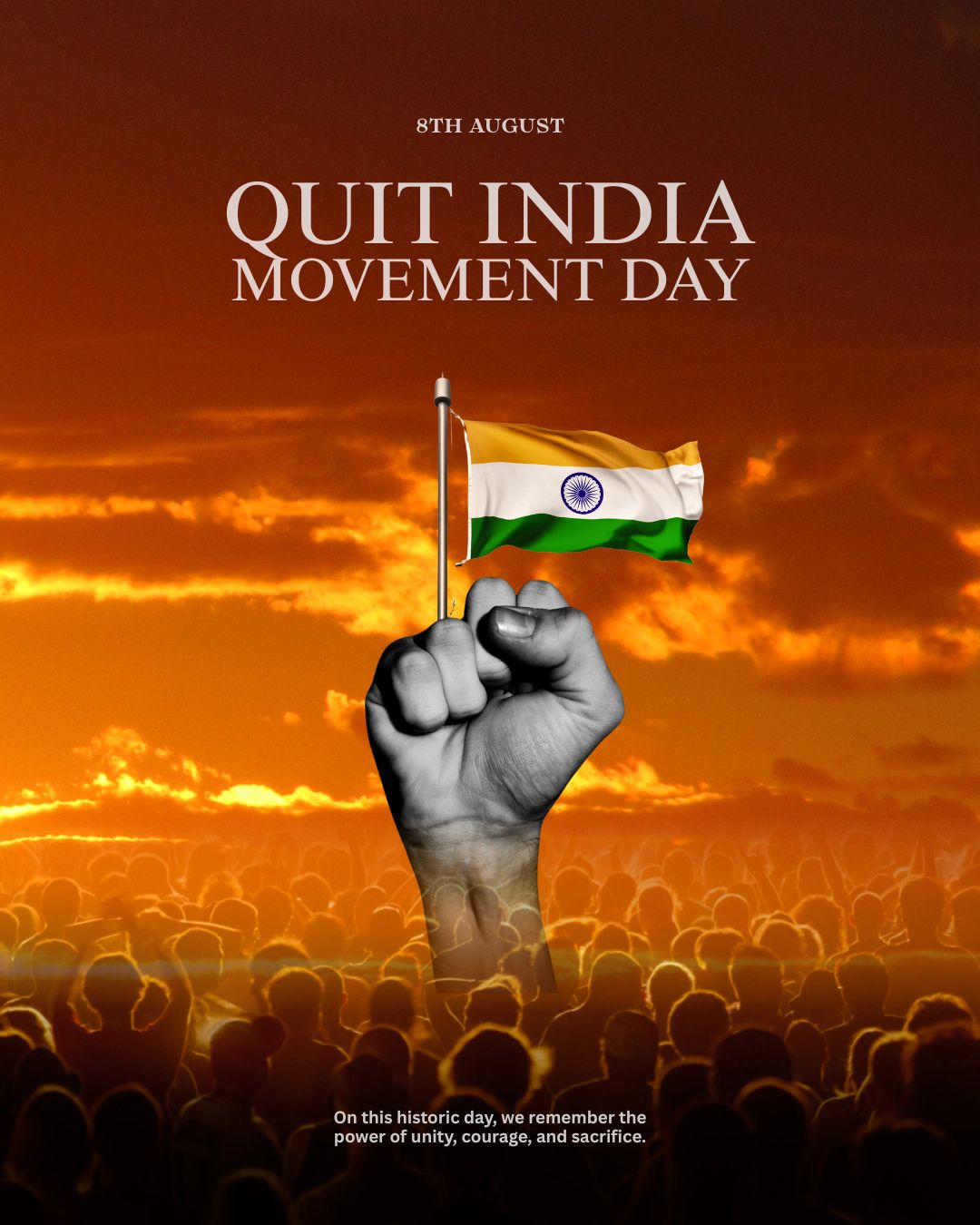
Quit India Movement Day 2026 will be observed on Saturday, 8 August 2026, commemorating one of the most significant milestones in India’s freedom struggle.
Also Read: Hiroshima Day 2026: Date, Theme, History, Importance, Interesting Facts & Peaceful Quotes
On this day in 1942, Mahatma Gandhi and the Indian National Congress launched the Quit India Movement, demanding an immediate end to British rule. Gandhi’s powerful “Do or Die” call inspired millions of Indians to unite for independence.
Despite widespread arrests and strict British repression, the movement strengthened the nation’s resolve for freedom. Today, the day honors the courage and sacrifices of India’s freedom fighters while reminding citizens of the importance of democracy, unity, and patriotism.
Quit India Movement Day 2026 Date
Quit India Movement Day 2026 will be observed on Saturday, August 8, 2026. This day marks the anniversary of the historic 1942 movement launched by Mahatma Gandhi to demand an end to British rule in India.
Quit India Movement Day 2026 Theme
Quit India Movement Day 2026 does not typically feature an official yearly theme set by the government like other modern campaigns. Instead, the core focus remains commemorating the historic 1942 “Do or Die” call given by Mahatma Gandhi for complete independence.
Quick Facts About Quit India Movement Day
- Observed On: 8 August
- Movement Started: 1942
- Led By: Mahatma Gandhi and the Indian National Congress
- Launch Venue: Gowalia Tank Maidan (now August Kranti Maidan), Mumbai
- Famous Slogan: “Do or Die”
- Objective: End British rule in India
- Importance: A major milestone in India’s freedom struggle
History of the Quit India Movement
The background of the Quit India Movement involves the Failure of the Cripps Mission, severe World War II economic hardships, and the Threat of Japanese invasion. Launched by Mahatma Gandhi on August 8, 1942, it demanded an immediate end to British rule with the famous “Do or Die” call.
Key Causes
- Cripps Mission Failure (April 1942): Sir Stafford Cripps offered only delayed Dominion Status rather than complete freedom, which the Indian National Congress rejected.
- World War II Pressures: Britain forced India into the global war without local consent, causing high inflation, food shortages, and public anger.
- Japanese Advance: The rapid advance of Japanese forces toward India’s borders made Gandhi feel that an immediate British departure was vital to protect the country.
Shift in Strategy
- Total Independence: Unlike earlier passive or gradual campaigns, this called for an immediate and unconditional end to colonial rule.
- Mass Uprising: Gandhi gave his “Do or Die” speech at Gowalia Tank Maidan in Bombay, urging all citizens to act as independent leaders if arrested.
Why Did the Quit India Movement Begin?
The Quit India Movement was launched because Indians had lost faith in British promises and wanted complete independence. Several political and economic factors convinced the Indian National Congress that British rule had to end immediately.
1. Failure of the Cripps Mission
In 1942, the British government sent the Cripps Mission to offer limited self-government after World War II. Since it did not promise immediate independence, Indian leaders rejected the proposal.
2. British Rule and Exploitation
For decades, Indians faced heavy taxes, economic exploitation, and restrictions on their rights. Growing dissatisfaction increased the demand for self-rule.
3. Impact of World War II
Britain involved India in World War II without consulting Indian leaders. This decision angered both political leaders and the public.
4. Demand for Complete Independence
Earlier movements had sought reforms, but by 1942 the demand had changed to complete freedom. The Indian National Congress believed independence could no longer be postponed.
5. Growing National Unity
People from different regions, communities, and backgrounds united with a common goal—to end British rule and build a free India.
Mahatma Gandhi’s “Do or Die” Speech
On 8 August 1942, Mahatma Gandhi delivered his historic speech at Gowalia Tank Maidan in Bombay (now Mumbai). During the session, he gave the inspiring call:
“Do or Die.”
This slogan encouraged Indians to continue the freedom struggle through non-violent resistance until independence was achieved. Gandhi urged people to remain peaceful, courageous, and united despite arrests and repression.
The message quickly spread across the country, motivating students, workers, farmers, and women to join the movement. Although many leaders were arrested the next day, the spirit of “Do or Die” kept the movement alive and became one of the most memorable slogans in India’s history.
Major Leaders of the Quit India Movement
Many national leaders played an important role in the Quit India Movement and inspired millions to fight for freedom.
Principal National Leaders
- Mahatma Gandhi: Led the movement and gave the Mahatma Gandhi “Do or Die” speech.
- Jawaharlal Nehru: Backed the mass protest and pushed for complete freedom.
- Sardar Vallabhbhai Patel: Helped rally people across the country before his arrest.
- Maulana Abul Kalam Azad: Headed the Maulana Azad Congress party during the launch.
- Dr. Rajendra Prasad: Organized public meets in Bihar to build local support.
Underground and Socialist Leaders
- Aruna Asaf Ali: Raised the national flag in Mumbai after top leaders were put in jail.
- Jayaprakash Narayan: Fled prison to run secret resistance operations.
- Ram Manohar Lohia: Led the hidden groups to keep the fight going.
- Usha Mehta: Ran the secret radio to share news with the public.
- Sucheta Kripalani: Managed the hidden wing of the freedom group.
- Yusuf Meherally: Created the Yusuf Meherally “Quit India” name.
Timeline of the Quit India Movement
The Quit India Movement unfolded through several important events that shaped India’s struggle for independence.
- March 1942: The Cripps Mission failed as it offered only post-war dominion status, which disappointed Indian national leaders.
- July 14, 1942: The Congress Working Committee met at Wardha and accepted the idea of a mass struggle.
- August 8, 1942: The All India Congress Committee passed the Quit India Resolution at Gowalia Tank Maidan in Bombay (Mumbai), where Gandhi gave his “Do or Die” speech.
- August 9, 1942: “eminent congress leaders like mahatma gandhi”, as noted in the Historical Archive, along with other top leaders, were arrested overnight by the British government.
- August–September 1942 (First & Second Phase): Widespread urban strikes, student protests, and intense rural peasant rebellions broke out, targeting railway tracks, telegraph wires, and government buildings.
- 1933–1945 (Third Phase): Underground resistance and localized parallel governments (Prati Sarkar) emerged in places like Ballia, Tamluk, and Satara.
- 1945: The movement effectively drew to a close with the unconditional release of jailed nationalist leaders after World War II.
- 15 August 1947: India achieved independence, fulfilling the dream of freedom.
Major Events During the Quit India Movement
Key Events and Milestones
- Failure of Cripps Mission (March–April 1942): “The immediate cause of the Quit India movement was the collapse of Cripps Mission.”
- Quit India Resolution (August 8, 1942): “The All India Congress Committee meeting at Bombay (August 8, 1942) passed the historic ‘Quit India Resolution’.” during the session at Gowalia Tank Maidan.
- The “Do or Die” Call: Mahatma Gandhi gave his famous mantra “We shall either be free or die in the attempt.”
- Mass Arrests (August 9, 1942): “By August 9, 1942, all senior Congress leaders were arrested, including Gandhiji himself.”
- Urban Strikes and Protests: Cities like Bombay, Ahmedabad, Delhi, and Patna saw immediate student strikes, worker walkouts, and public demonstrations.
- Public Sabotage: “The British faced protests, boycotts, and sabotage activities such as cutting of telegraph wires and attacks on government buildings.”
- Underground Resistance: “As Congress leaders were imprisoned, younger activists and clandestine networks assumed control… like Usha Mehta, Aruna Asaf Ali, etc.”
- Parallel Governments Established: “In Ballia, Uttar Pradesh, a government was run by Chittu Pandey. In Tamluk, Bengal, the Jatiya Sarkar… In Satara, Maharashtra, the Prati Sarkar”.
- Brutal British Suppression: “An estimated 100,000 people were arrested, and thousands were killed or injured in police firing and military actions”.
Impact of the Quit India Movement
Although the Quit India Movement did not immediately end British rule, it became a major turning point in India’s freedom struggle.
Strengthened the Demand for Independence
The movement made it clear that Indians would no longer accept colonial rule and wanted complete independence.
United the Nation
People from different regions, religions, and communities joined together with a shared goal of freedom.
Inspired Future Freedom Efforts
The courage shown during the movement encouraged continued resistance against British rule in the following years.
Weakened British Authority
The widespread protests demonstrated that British control over India was becoming increasingly difficult to maintain.
Honored the Spirit of Sacrifice
Thousands of freedom fighters faced imprisonment and hardships, leaving behind a legacy of courage and patriotism.
Paved the Way for Independence
The movement increased pressure on the British government and became one of the key milestones leading to India’s independence on 15 August 1947.
Why Is Quit India Movement Day Celebrated?
Quit India Movement Day is observed every year on 8 August to remember the launch of the Quit India Movement in 1942 and honor the sacrifices of India’s freedom fighters. It serves as a reminder of the courage, unity, and determination that helped India move closer to independence.
The day also encourages citizens, especially young people, to respect democratic values, protect the nation’s freedom, and learn about the struggles that shaped modern India.
How Quit India Movement Day 2026 Will Be Celebrated
Across India, schools, colleges, government offices, and cultural organizations commemorate the day through various activities, including:
- 🇮🇳 Patriotic speeches and seminars
- 🎭 Cultural performances and patriotic songs
- 📚 Essay writing and quiz competitions
- 🎨 Poster-making and drawing contests
- 🌺 Floral tributes to freedom fighters
- 🏛️ Museum exhibitions and history programs
- 📱 Social media campaigns using patriotic messages and hashtags
Interesting Facts About the Quit India Movement
- Do or Die: Mahatma Gandhi gave his famous “Do or Die” speech on August 8, 1942, urging Indians to fight for freedom.
- August Kranti: The movement is also known as August Kranti because it started on August 9, 1942.
- Leaderless Revolt: The British arrested all major leaders on day one, making it a leaderless public uprising.
- Underground Radio: Activist Usha Mehta ran a secret underground radio station to share news with the public.
- New Leaders: Young leaders like Aruna Asaf Ali and Ram Manohar Lohia stepped up during the protests.
- Parallel Governments: Brave locals set up rival governments in places like Ballia, Satara, and Tamluk.
- Mass Arrests: The British jailed over 60,000 to 100,000 people by the end of 1942.
- No Universal Support: Groups like the Muslim League and the Communist Party did not join the struggle.
- Active Women: Women took a very active role in leading protests and facing police action.
- Path to Freedom: It proved India was ungovernable, helping set up the transfer of power in 1947.
Inspirational Quit India Movement Day 2026 Quotes
“Freedom is earned through courage, unity, and sacrifice.”
“The spirit of the Quit India Movement reminds us that determination can change history.”
“Let us honor the heroes whose sacrifices gifted us an independent India.”
“True patriotism means protecting the freedom won by our freedom fighters.”
“The courage of 1942 continues to inspire every generation of Indians.”
Quit India Movement Day 2026 Wishes
- 🇮🇳 Wishing you a meaningful Quit India Movement Day 2026. Let us honor the heroes who fought for our freedom.
- 🌸 May this day inspire us to value unity, democracy, and the sacrifices of our freedom fighters.
- ✨ Let us remember the brave souls whose courage shaped India’s future. Happy Quit India Movement Day!
- 🇮🇳 Celebrate the spirit of patriotism by remembering the sacrifices made for our nation’s independence.
- ❤️ On this historic day, let us pledge to uphold the values of freedom, peace, and national unity.
Frequently Asked Questions (FAQs)
1. When is Quit India Movement Day 2026 observed?
Quit India Movement Day 2026 will be observed on Saturday, 8 August 2026.
2. Why is Quit India Movement Day celebrated?
It is celebrated to commemorate the launch of the Quit India Movement in 1942 and to honor the sacrifices of India’s freedom fighters.
3. Who started the Quit India Movement?
The movement was launched by Mahatma Gandhi under the leadership of the Indian National Congress.
4. What was the famous slogan of the Quit India Movement?
The movement is best known for Mahatma Gandhi’s inspiring slogan, “Do or Die.”
5. Where was the Quit India Movement launched?
It was launched at Gowalia Tank Maidan (now August Kranti Maidan) in Mumbai on 8 August 1942.
6. What was the main objective of the Quit India Movement?
Its main objective was to demand an immediate end to British rule and achieve complete independence for India.
7. What is the significance of Quit India Movement Day today?
The day reminds us of the courage and sacrifices of freedom fighters while encouraging citizens to uphold democracy, unity, and patriotism.
Conclusion
Quit India Movement Day 2026 is a tribute to the courage, unity, and determination of millions of Indians who stood against colonial rule. The movement, launched on 8 August 1942, marked a decisive chapter in India’s freedom struggle and strengthened the demand for complete independence.
As we observe this important day, let us honor the sacrifices of the freedom fighters who dreamed of a free and democratic India. Their legacy inspires us to protect our nation’s values, respect our Constitution, and work together for a stronger and more united future.